Tuesday, January 3, 2012

From Hydrogen to Tellurium - CADMIUM

Cadmium 
The 48th element is 
Cadmium  and is symbolised using the letters Cd.
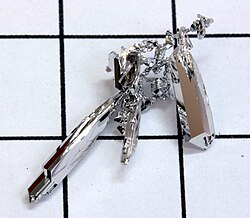
Cadmium is a silver metal, but although it is next to silver on the periodic table it's colourful is the only similar trait the two elements have.
Cadmium  is a soft metal which can be easily cut with a knife. Another important thing to mow is that it is toxic and therefore it is unlikely that you will come across it in a school setting.

It's most common use is in Ni-Cd batteries - rechargeable batteries.


Experiment of the week
To compare Ni-Cd and NiMH (Nickel Metal hydride) batteries.

You will need
An AA Ni-Cd battery
a AA NiMH battery
2 2.5V light bulbs
2 bulb holders
2 AA battery holders with flying leads
4 crocodile clips
Timer
Adult supervision

What to do
Ensure the batteries are fully. Barged.
Make up 2 circuits with the bulbs in the bulb holders connected to the battery holders.
Insert the Ni-Cd battery into one circuit and the NiMH battery into the other circuit.both the lights should light.
Start the timer.
Measure how long both bulbs light for to measure which battery is the best.

From Hydrogen to Tellurium - SILVER


Silver

Number 47 on the periodic table is silver, a well known metal which most of you will be familiar with. It has a characteristic "silver" colour. This metal is quite rare and therefore valuable. It is used in jewellery as it is malleable. The fact that it is very stable in air also increases it's suitability for use in jewellery and other decorative and useful items. Because it doesn't react with air it keeps it's nice shiny silvery appearance.


The chemical symbol for  silver  is Ag. This symbol comes from the Latin name for silver Argentum.

Silver is found as an ore so it can be mined in the same way as we mined the chocolate chips from cookies when we were investigating copper earlier in the year.

Silver has no known biological role and isn't found in the human body.

Silver doesn't support the growth of bacteria and is therefore often used for chalices where many people are going to drink from the same cup.


As well as being used in jewellery and silverware, 
silver  is also used in photography, mirror production, for coins and dentistry. A compound of  silver , silver iodide is used to get rain clouds to rain.

Silver forms compounds with the halides, hydrogen, fluorine, chlorine, bromine and iodine. It also forms compounds with covalent elements such as oxygen, sulphur,
Selenium and tellurium.


Experiment of the week
To see if bread soda solution or washing soda make a better silver cleaner.

You will need:
2 Aluminium foil trays
Washing soda
Bread soda
Hot water
2 pieces of silver equally tarnished
A spoon
A timer
Adult supervision

What to do:
Put apiece of dirty or tarnished silver into each aluminium foil tray. Foil containers used by take away restaurants for rice are ideal.
Put a spoon of washing soda into one tray and a spoon of bread soda into the other one.
Pour equal amounts of hot water into each container.
Start the timer.
After 2 minutes remove both pieces of silver and compare. Which cleaning solution resulted in the cleanest silver?
Report your findings below.


Additional experiment - Compare your home made cleaning solution to a commercially available one.

Monday, November 14, 2011

From Hydrogen to Tellurium - Palladium

Palladium , Pd is the 46th element. Like the elements I wrote about for the last couple of weeks, palladium is also in the platinum metals group. It's uses are similar to those of rhodium - a catalyst in catalytic converters, electrical connections and jewellery.Palladium has no known biological role and is not present in the human body.

From Hydrogen to Tellurium - Rhodium

Rhodium Rh at number 45 is another slivery white transition metal. It is also in the platinum group.My research tells me that it is used in alloys, jewellery, In electrical applications and as a catalyst. Rhodium is extracted from ore by industry. It is not present in the human body and though the metal itself is not toxic many rhodium compounds are toxic amdalso cause cancer.

Sunday, October 30, 2011

From Hydrogen to Tellurium - RUTHENIUM


Ruthenium


Calendar week 44 in this the International Year of Chemistry means element number 44 and that is Ruthenium with the chemical symbol Ru.. This transition metal has 44 electrons and therefore is in 44th position. This white metal is often grouped with rhodium, palladium, osmium, iridium, and platinum to make up the Platinum group metals.


Ruthenium doesn't react with air at normal temperatures and because of this it doesn't tarnish.
It was first discovered in Russia in the mid 1800s and was named after the latin name for Russia - Ruthenia. Ruthenium is sometimes found as a free metal, often along with other platinum group metals.
Ruthenium is very rare so people are unlikely to come across any ruthenium compounds in normal day to day activities however they these chemicals are considered toxic to humans.

Monday, October 24, 2011

From Hydrogen to Tellurium - TECHNETIUM

Technetium

The 43rd element is Technetium. It has the atomic symbol Tc. My knowledge of this element is very limited. In my research for this blog I discovered it it radioactive - a bye product of the radioactive decay of uranium. It has no biological role and is not found in nature. Apparently it was the first element to be synthesized. It was made by bombarding molybdenum with deuterium.

Sunday, October 16, 2011

From Hydrogen to Tellurium - MOLYBDENUM


Molybdenum


At position 42 is another transition metal - Molybdenum. It sits in the middle of the transition metals with Chromium above it and Tungsten below it. Molybdenum is known by the chemical symbol Mo. It has 4 electrons in its outer orbital and forms compounds with many other elements including hydrogen, fluorine, chlorine, oxygen, nitrogen and sulphur.


Molybdenum doesn't exist as elemental metal in nature but it can be isolated from its oxide. The isolated metal is a silvery white colour.


Small traces of Molybdenum are necessary for life in all species.


Because it doesn't expand or soften when heated to very high temperatures Molybdenum is used in applications that have to withstand very high temperatures. It is added to steel to increase the strength.