Strontium
Strontium is number 38 and has the chemical symbol Sr. In the same group as Magnesium and Calcium, Strontium is one of the Alkali Earth Metals. Strontium is very reactive with both water and air and therefore doesn't exist naturally in its elemental form. When isolated the metal is a silvery grey colour, however it reacts in air to give a yellowish coloured compound.
It was discovered in Scotland and it is named after the village - Strontian where it was discovered.
Students come across Strontium in their studies because when burned its salts give a characteristic red colour. This characteristic or trait also mean that it is commonly used in fireworks to give a red colour.
Below are links to a couple of video clips showing strontium salts burning with their characteristic red flame.
http://www.youtube.com/watch?v=vltFchuGi0Y
http://www.youtube.com/watch?v=BGd-bCpLDvE&feature=related
Monday, September 19, 2011

Monday, September 12, 2011
From Hydrogen to Tellurium - Rubidium
Rubidium
For the 37th element, we jump back to the left hand side of the periodic table. Rubidium, with the chemical symbol Rb, is an Alkali Metal in the same group as Hydrogen, Lithium, Sodium and Potassium. What you. Should remember about these elements is that each of them have only one electron in their outer shell making them very reactive. In fact, rubidium is the most reactive we have met so far. The increase in reactivity is due to the distance of the outer electrons from the nucleus - the further away the electron is from the nucleus the less tightly the atom can hold onto the electron. Rubidium is very reactive in air and burns spontaneously in water.
Rubidium is a metal, solid at room temperature, but with a melting point of 40 degrees centigrade.
Rubidium is the 23rd most common element in the earth's crust. It is also present dissolved in sea water.
For the 37th element, we jump back to the left hand side of the periodic table. Rubidium, with the chemical symbol Rb, is an Alkali Metal in the same group as Hydrogen, Lithium, Sodium and Potassium. What you. Should remember about these elements is that each of them have only one electron in their outer shell making them very reactive. In fact, rubidium is the most reactive we have met so far. The increase in reactivity is due to the distance of the outer electrons from the nucleus - the further away the electron is from the nucleus the less tightly the atom can hold onto the electron. Rubidium is very reactive in air and burns spontaneously in water.
Rubidium is a metal, solid at room temperature, but with a melting point of 40 degrees centigrade.
Rubidium is the 23rd most common element in the earth's crust. It is also present dissolved in sea water.
Monday, September 5, 2011
From Hydrogen to Tellurium - KRYPTON
Krypton
Krypton is the chemical element with the atomic number 36 and the chemical symbol Kr. In the periodic table it is positioned at the end or right hand side of the fourth row, underneath Helium, Neon and Argon. This tells us that it has the right amount of electrons to fill its outer electron shell. We have already learned that elements with full outer electron shells are not reactive and Krypton is no exception. It is the next member of the inert gas family.

Interestingly, Krypton has been used in defining the length of a meter. According to www.surveyhistory.org The French originated the meter in the 1790s as one/ten-millionth of the distance from the equator to the north pole along a meridian through Paris. It is realistically represented by the distance between two marks on an iron bar kept in Paris. The International Bureau of Weights and Measures, created in 1875, upgraded the bar to one made of 90 percent platinum/10 percent iridium alloy.
In 1960 the meter was redefined as 1,650,763.73 wavelengths of orange-red light, in a vacuum, produced by burning the element krypton (Kr-86). More recently (1984), the Geneva Conference on Weights and Measures has defined the meter as the distance light travels, in a vacuum, in 1/299,792,458 seconds with time measured by a cesium-133 atomic clock which emits pulses of radiation at very rapid, regular intervals.
None of the definitions changed the length of the meter, but merely allowed this length to be duplicated more precisely.

Experiment of the week
Super strong paper
Given that Superman is so strong, it seems fitting to investigate the strength of paper this week.
You will need:
3 A4 sheets of 80g/m2 paper
3 empty spreadable butter containers or similar
a ruler
sand or small weights to load weight onto your bridge
a spoon
adult supervision
What to do
Position 2 of the butter containers 15 cm apart
Use the 3 sheets of paper to bridge the gap
Put the third empty container onto your bridge and slowly fill it with sand.
How much sand can you load onto the bridge before it collapses?

Who can make the strongest bridge?
Post your results and photos below
Tuesday, August 30, 2011
From Hydrogen to Tellurium - BROMINE
Bromine
At number 35 is Bromine with the chemical symbol Br. Another non-metal, Bromine is the first element we have come across that is a liquid at room temperature. It is a red/brown liquid and when heated it boils to produce a red/brown gas at 60°C.
 Bromine is in the same group as fluorine and chlorine and is therefore a halogen. Halogens are very reactive, they have space for one more electron in their outer electron shell and are very keen to fill that space by taking an electron from anything that will give them one. In terms of reactivity Bromine is less reactive than fluorine or chlorine but more reactive than iodine which in in the row below it in the table.
Bromine gas has a horrible smell. It is suffocating so not a good idea to have it around. Bromine liquid is corrosive to human tissue. The name Bromine comes from the Greek word Bromos which means stench.
Bromine is extracted from natural brine deposits taken from salt springs.
It is used as a dye, in pesticides and as a flame retardant in plastics.
At number 35 is Bromine with the chemical symbol Br. Another non-metal, Bromine is the first element we have come across that is a liquid at room temperature. It is a red/brown liquid and when heated it boils to produce a red/brown gas at 60°C.
Bromine gas has a horrible smell. It is suffocating so not a good idea to have it around. Bromine liquid is corrosive to human tissue. The name Bromine comes from the Greek word Bromos which means stench.
Bromine is extracted from natural brine deposits taken from salt springs.
It is used as a dye, in pesticides and as a flame retardant in plastics.
From Hydrogen to Tellurium - SELENIUM
Selenium
Selenium is the 34th element, a nonmetal, it has 2 allotropes - a purple/gray one and a red one, the purple/gray one being the most stable. Its chemical symbol is Se.

It is rarely found in nature but occurs as a compound in minerals.
The purple/gray allotrope is a semi conductor and it has an unusual property - it is a better conductor in the light than in the dark.
At number 34, Selenium has 34 electrons. This means that it has 2 spaces in its outer shell - just like oxygen and sulphur. Selenium forms similar compounds to sulphur - SeO2 and H2Se for example
Although it is extremely toxic in large doses, it is present at trace levels in humans and thought to be essential for the correct functioning of the body. We get our Selenium from eating plants and animals that contain Selenium. Brazil nuts have the highest concentration of any food. It is also contained in crab and lobster meat.
Selenium is the 34th element, a nonmetal, it has 2 allotropes - a purple/gray one and a red one, the purple/gray one being the most stable. Its chemical symbol is Se.
It is rarely found in nature but occurs as a compound in minerals.
The purple/gray allotrope is a semi conductor and it has an unusual property - it is a better conductor in the light than in the dark.
At number 34, Selenium has 34 electrons. This means that it has 2 spaces in its outer shell - just like oxygen and sulphur. Selenium forms similar compounds to sulphur - SeO2 and H2Se for example
Although it is extremely toxic in large doses, it is present at trace levels in humans and thought to be essential for the correct functioning of the body. We get our Selenium from eating plants and animals that contain Selenium. Brazil nuts have the highest concentration of any food. It is also contained in crab and lobster meat.
Monday, August 15, 2011
From Hydrogen to Tellurium - ARSENIC
Arsenic

The 33rd element is Arsenic. This element I associate with all sorts of sinister things - murders, poisonings, mystery and intrigue. In Agatha Christie novels it was one of the main causes of death in her victims.
Toxic chemicals are labelled by scientists with the scull and crossbones
 to warn users to be especially careful with them, though it is recommended that chemists treat all chemicals as if they might be toxic to prevent any unwelcome surprises.
In terms of its properties or traits, Arsenic is a metalloid or semi metal, sitting in the periodic table between the metals and the non-metals. Arsenic occurs in a range of minerals as well as in its elemental form. In its elemental form it is usually a gray crystalline solid but like carbon and phosphorus, it has other allotropes. When heated it goes straight from a solid to a gas - we call this subliming.
Arsenic forms compounds with many other elements - oxygen, sulphur, etc
In the past arsenic compounds have been used as insesticides, weedkillers and wood preservatives. Thanks to the Elements exhibition in the Science Gallery I also learned that Arsenic compounds were also used by interior designers to give a green colour to wall papers.
A modern day use for Arsenic is in the computer industry where it is used for its semiconductor abilities.
Thursday, August 11, 2011
From Hydrogen to Tellurium - GERMANIUM
Germanium
Germanium, with 32 electrons, is the 32nd element in the table. During the week I came across this very colourful periodic table and have included it because it shows the different chemical groups in different colours. As you can see, Germanium is one of the semi metals often called metaloids. It is one that prior to this week I knew very little about.

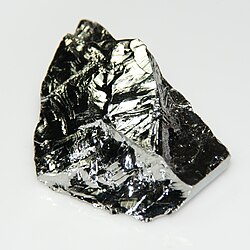
Its main use is in the computer industry where it is used in semi conductors.
Interestingly, Germanium has a low toxicity in mammals but is highly toxic to some bacteria. Investigations are going on into its use as a means of killing bacteria or treating bacterial infections.
In some factories Germanium dioxide is used to help start the reaction used in the making of PET for drinks bottles.

Subscribe to:
Posts (Atom)