Monday, May 16, 2011

From Hydrogen to Tellurium - CALCIUM

Calcium


Positioned next to Potassium and under Magnesium is Calcium. With the chemical symbol Ca and 20 electrons, Calcium is an element most children have heard about.


It is not naturally found in its elemental state - in other words you don't find lumps of calcium atoms on their own but when scientists remove the other elements leaving just Calcium they are left with a soft, grey / silver metal.


Calcium is grouped with Beryllium and Magnesium in the group known as the Alkali Earth Metals.
You may well have heard your parents encouraging you to drink milk, telling you that milk will give you strong teeth and bones. Milk is one of the foods that is rich in Calcium and Calcium is needed by the body. In fact our bodies are 5 per cent Calcium so for every 100g of our bodies 5 g are Calcium, and most of this Calcium is in our banes and teeth. It is the presence of Calcium in our bones that makes them opaque to x-rays. This characteristic is widely used to check to see if bones have been broken.


Calcium is also the fifth most abundant element in the earth's crust. Many rocks contain Calcium  - limestone and chalk are both made from the Calcium containing compound Calcium Carbonate CaCO3. In caves, stalactites and stalagmites are Calcium containing compounds which have dissolved in water and moved through the rocks.


The mortar builders use to stick bricks together is a mixture of Calcium Hydroxide, known as lime, Sand and Water.


Cement is also made fromCalcium containing compounds.


Many Calcium containing compounds are not soluble in water but dissolve in other solvents such as acids. This means that buildings do not dissolve in rain but if you get acid rain which is caused by pollution then this acid rain can dissolve buildings. This can cause serious damage to old decorative buildings


Experiment of the Week
Dissolving egg shells


You will need
adult supervision
2 jam jars or jars with lids that seal
Water
Vinegar
2 eggs
Hot water
Basin containing cold water
bottle with a large neck such as the one in this picture - 


What to do
Carefully place a raw egg into each of the 2 jam jars.
Cover one with water and put on the lid.
Cover the other with vinegar and put on the lid.
After 24 hours remove the lids and carefully pour off the liquids. Compare the 2 eggs. The one which was in the vinegar should be soft - its shell dissolved in the vinegar.
Fill the large necked bottle with hot water and then pour the water out.
Sit the rubbery egg on top of the bottle.
Cool the bottle by immersing it in the cold water.
Your egg should be sucked into the bottle.

Monday, May 9, 2011

From Hydrogen to Tellurium - POTASSIUM

Potassium


Potassium, with the chemical symbol K, is number 19. Last week we discussed Argon, the inert gas, with its outer electron shell full. This means that Potassium with one extra electron must have three full shells and only one electron in its outer shell. The symbol K comes from the Kalium - the Latin name for this material.


We have talked previously about how elements with the same number of electrons in their outer shells behave similarly chemically and scientists who noticed this started to group the elements according to this. They represented these groups in a now famous diagram known as the periodic table of elements. This week as well as talking about Potassium I am going to introduce you to this famous diagram. Each week we will add our new Element of the Week. It will be shaded in blue and have a red outline.
All the elements we have already discussed are included. Any that are gases at room temperature I have shaded in green. The metals are silver, the solids red and the metalloids purple.


So what about our element of the week, Potassium? Well, it is in the alkali metal group with Sodium and Lithium. Like Sodium, it is very reactive - just mad to give away its outer electron. Lumps of Potassium aren't found in nature because it has long since given away its outer electron to form a compound with some other electron hungry species. Scientists have prepared pieces of Potassium but to keep it you have to store it in oil. It burns in the air giving a purple coloured flame. Check out this video to see what happens
http://www.youtube.com/watch?v=8HdAhs_-Y2g


 It burns in water......check out this video...
http://www.youtube.com/watch?v=veR3gNXs8LQ&NR=1

Potassium containing compounds also give a purple flame when they are burned.

Although it is not found on its own, Potassium is very plentiful on the earth. It exists in many compounds. It is essential for both plant and animal like.
Plants absorb Potassium salts from the earth and if you burn a plant you are left with a substance we call potash - the ash of Potassium!
Farmers add Potassium fertilisers to their fields to help plant growth.


Potassium salts are also dissolved in the sea.


Potassium is essential for human life and each human body is 0.2% Potassium.
To calculate how much Potassium your body contains take your weight in kg and multiply by 0.002. If you weigh 40 kg for example, 80g of that is Potassium! We get Potassium from fruit, nuts and vegetables with potatoes, bananas and dried apricots often being mentioned as good sources.


In our bodies we use Potassium to help our brains work properly, to help our muscles work well and to keep our fluid levels balanced.


People who are concerned about eating too much Sodium in their diets, but like their food to taste salty often use LoSalt. LoSalt is a mixture of Sodium Chloride (table salt) and Potassium Chloride.


Experiment of the Week:
Work out how much potassium your body contains


You will need:
Weighing scales
Calculator or pen and paper


What you do:
Weigh yourself.
Multiply your weight by 0.002


The answer is the amount of your body that is Potassium!


Monday, May 2, 2011

From Hydrogen to Tellurium - ARGON


Argon


Argon with the chemical symbol Ar is number 18. It is located on the periodic table in the third row of the right hand column underneath Helium and Neon. Like Helium and Neon, Argon is a member of the inert or noble gas family. This means that it is a gas at room temperature and that it is a very stable material that does not react with other elements, or itself for that matter.
Vial containing a violet glowing gas


Previously we have talked about the fact that air is a mixture of gases - mostly Nitrogen (78 parts of every 100) and oxygen (21 parts of every 100). Of the remaining 1 part a large amount of that is Argon.


At number 18, Argon has 2 electrons in its inner shell and 8 in each of the 2nd and 3rd shells. This means that all 3 electron shells are full. It is these full electron shells which make Argon so stable - it is neither looking for additional electrons to fill up the last few spaces nor looking to give away a few electrons to empty the outer shell.


The name Argon comes from the Greek word for lazy - very appropriate for an element which just won't react!


I was asked recently why the inner electron shell only has 2 electrons and the 2nd and 3rd 8. Well this is because in close to the nucleus the inner shell is very small and can only fit 2 electrons. The 2nd and 3rd shells are bigger and can fit 8 each. When we move on to the next row we will see that the 4th shell is considerably bigger and can fit an extra 10 electrons.


I was also asked about the position of the columns and the gaps in the first 3 rows. Well the elements are grouped in columns along with other elements with similar chemical behaviour. Helium behaves similarly to Neon and Argon so is placed in that group - it is in the group with full outer shells, not the group with 2 electrons in the outer shell.


So what is Argon used for? Well the main use is in situations when you want to prevent other reactions taking place so Argon is used for welding. It is also sometimes used as a preservative and also as a fire extinguisher.


Like Neon it becomes coloured when an electrical current is passed through it so it is used to make blue/purple advertising signs.

Monday, April 25, 2011

From Hydrogen to Tellurium - CHLORINE


Chlorine


The seventeenth element is Chlorine. It has 17 electrons, 2 in the inner shell, 8 in the 2nd and 7 in the third, thus leaving one space in the outer shell to completely fill it. Elements with one space in their outer shells are grouped in the Halogen family. This is the second halogen we have met, Fluorine being the first.


Chlorine is a green coloured gas which was first isolated in the 1770s. The gas is poisonous. It also has a bleaching effect, taking the colour out of things it comes in contact with. The gas is not found in nature as Chlorine is very reactive and combines with other elements to give compounds. 


Most people are familiar with the smell of Chlorine - it is used in very small quantities in our drinking water and also in swimming pools to kill bacteria.


One of the compounds, Sodium Chloride, is used regularly in our kitchens - we refer to it as salt. It seems hard to believe that if the gaseous molecules of Chlorine combine with the metal atoms of sodium that a white crystalline solid which we know as salt results.

Sunday, April 17, 2011

From Hydrogen to Tellurium - SULPHUR

Sulphur


The sixteenth element, Sulphur is given the symbol S. This element is found in its elemental form, often near volcanos and springs. It is a yellow crystalline solid, composed of rings of 8 Sulphur atoms.


It has been known about since ancient times and is the material referred to as "brimstone" in the bible. 


Sulphur is a non-metal which sits under oxygen in the periodic table. Like oxygen if forms compounds with 2 other atoms -chemists say it is divalent. An example of a divalent compound of Sulphur is Hydrogen Sulphide - H2S. Hydrogen Sulphide is a colourless, poisonous gas that smells like rotten eggs. 


It can also form molecules with different number of bonds. An example is Sulphur Dioxide, SO2 where it is joined by double bonds to both oxygens. Sulphur dioxide is sometimes used to preserve fruit for jam making.


Sulphur dioxide is produced when coal is burned. This SO2 reacts with water H2O in the atmosphere to form Sulphuric Acid H2SO4. This then falls as acid rain and affects crop growth and damages buildings.


In fact Sulphur forms compounds with all elements except the noble gases.


If you heat Sulphur with iron you get a new compound - iron sulphide. This experiment is often used to show the difference between a chemical mixture and a reaction producing a new material. Before heating this mixture the iron could be separated from the Sulphur using a magnet. Once it has been heated and reacted the new compound is not magnetic, nor can the magnet separate the iron from the Sulphur.


Many Sulphur containing compounds are smelly. You might be familiar with the sulphury smell from car's catalytic converters. Garlic and the Skunk also owe their smell to Sulphur containing compounds. 


Experiment of the week
To examine the effect of Acid Rain on crops


You will need:
4 clear plastic tubs with lids (3kg Margarine containers are ideal.)
Kitchen roll
Pea seeds
Water
Vinegar
spoon


What to do:
Soak the peas overnight in water
In each of the 4 tubs cover the bottom with a few layers of kitchen roll. Dampen the kitchen roll well with water
Sprinkle pea seeds on the damp kitchen roll.
Label the containers 1,2 3 and 4
Put the lid onto container 1 and leave in a warm place
To container 2 add 1 spoon of vinegar. Put on the lid and leave alongside container 1.
To container 3 add 2 spoons of vinegar. Put on the lid and leave alongside container 1.
To container 4 add 3 spoons of vinegar. Put on the lid and leave alongside container 1.


Examine each day for the next 2 weeks and record your results.


Which set of peas will grow best?


Monday, April 11, 2011

From Hydrogen to Tellurium - PHOSPHORUS

Phosphorus 


At number 15 and with the chemical symbol P, we find Phosphorus. In the periodic table Phosphorus sits below Nitrogen. Like Nitrogen, Phosphorus has 3 electrons in its outer shell and therefore reacts similarly to nitrogen.
It is a non-metal and like many other elements it is not found as an element in nature.
Elemental Phosphorus forms many different crystal structures and each structure has its own colour. White, Red and Violet Phosphorus are 3 such forms. We found previously that carbon exists in a number of different forms and that the different carbon allotropes look and feel very different. This is also the case for Phosphorus.
Different allotropes of Phosphorus


Phosphorus was discovered by a German alchemist when he was trying to turn urine into gold. Instead of gold he ended up with a white material which glowed in the dark and when lit, burned very brightly. 


Because Phosphorus can glow in the dark it is often used on the faces of watches so you can tell the time in the dark. 


Because it can burn so well, it is used on the rough part of match boxes that is used to strike matches on.
Phosphorus is essential for both animal and plant life. DNA contains Phosphorus as do many plant fertilisers. It is also found in washing powder

Monday, April 4, 2011

From Hydrogen to Tellurium - SILICON


Silicon


At number 14 is the unusual element Silicon with the chemical symbol Si. Why do I say it is any more unusual than the others? Well with its 4 outer shell electrons, it sits in the periodic table just under Carbon. We already learned that carbon is a non-metal. We have also learned that the elements with the same number of outer shell electrons behave similarly. When it comes to Silicon however this is not quite true. Silicon has some properties of a metal and some of a non-metal posing problems for scientists as to which group it should be in. In the end they decided it should go into a group called metaloids - a material with some metal and some non-metal characteristics. We also found out a few weeks ago that Boron has this same part metal, part non-metal behaviour.


This nearly metal behaviour is what makes Silicon interesting and very important to our lives today. It is known as a semiconductor because it doesn't conduct electricity as well as a metal but it is better at conducting than a non-metal. Semiconductors are widely used in the electronics and computer industries.


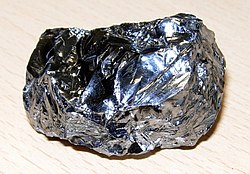
So what is it like? Well, Silicon is grey with a metallic appearance. It is very plentiful in the universe, but is hardly ever found as elemental Silicon. Instead it is found combined with oxygen as silica, SiO2. Sand is made of silica and this sand is in turn used to make glass. Small bags of Silica are also often found packed with shoes or in new handbags. The job of these little packets is to absord water so the leather products don't get damp.


Pure crystalline Silicon dioxide resonates at a certain frequency and because of this property it is used in watches.


Silicon combines with carbon oxygen and hydrogen to make a series of polymers known as silicones. You might have come across such rubbery polymers  - the wristbands which were very popular a few years ago were made from silicone..